Note:
The attached Proposed Public Access & Recreation Policy reflects the feedback of Arch Cape rate payers and lot owners on: 1) the draft policies that were recommended by the National Park Service’s (NPS)-facilitated Arch Cape Forest and Rainforest Reserve Public Access Team, and 2) three additional issues that had been surfaced by the Arch Cape community but were not addressed within NPS’s specific policy recommendations. This feedback was captured via a survey, the results of which can be viewed by clicking here.
By October 10, please submit any/all comment by email (Click here) or to any Board Member. The Board will consider these when they finalize the policy at the October Board Meeting.
Proposed Policy
The Arch Cape Forest is a resource of the Arch Cape Water District. Its intended purpose is protecting the quality and quantity of the Community’s drinking water which finds its source in the watershed and streams through it. Towards that end, the District would like to keep to a minimum the vehicular, bicycle and foot traffic that may threaten the environment and its water.
This Public Access & Recreation Policy balances the objective of protecting the source water with the requirement to provide some level of public access and recreation. Not promoting / publicizing the Forest as a recreational site or destination and not allowing for vehicular site visits / tours will allow the District to strike this balance.
Outlined below are the specific public access and recreation policies of the Arch Cape Water District.
Public Access
- Public access into the Arch Cape Forest, by foot or bicycle, is via the Hug Point Road gate or through adjacent properties with public access.
- Public access is permitted one hour before sunrise to one hour after sunset.
- Expect closures during fire season and when forest management operations are taking place in an area.
- “Pack it in, pack it out”. All trash/waste (including human solid waste) must be removed by user. People are encouraged to use “Leave No Trace” principles.
- Motorized vehicles, to include but not limited to trucks, cars, motorcycles and E-bikes, are not allowed except for emergencies or for Arch Cape Water District business with permission from the Arch Cape Water District Manager.
Restricted Access
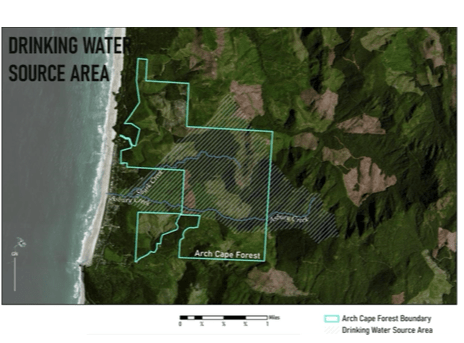
Within the Arch Cape Forest, the Drinking Water Source Area (DWSA), and other areas with sensitive natural resources, will be marked as no access. (See Map below of the Forest and the DWSA & picture of the signs that will denote restricted area – when those signs become available or click here for a more detailed map.)
Allowed Activities
- Hikers and bicycles must stay on maintained, rocked roads. No off-road use. No creating new trails.
- Hunting is allowed for Deer, Elk, Bear and Cougar in the Arch Cape Forest consistent with Oregon Department of Fish and Wildlife (ODFW) regulations.
- Recreational foraging, including plant leaves and flowers, mushroom, and berry collection, is allowed for personal, non-commercial use. Removal of wood products is not allowed.
- Dogs are allowed in the Arch Cape Forest on-leash or under direct owner control. Removal of Dog waste is encouraged.
Prohibited Activities
- Fire and fireworks
- Horses
- Drones
- Camping
- Alcohol, Drug Possession / Use
Upon final adoption of the policy, the following implementation steps will be taken:
- Ask the Forest Management Committee for recommendations pertaining to: a) whether/how to enforce the policies, and b) which of the policies should be posted at the public access areas.
- Provide a link where people can view the current open/close status (when there are fires or safety closures, etc.)
- Provide a number to call for the District Manager to report an emergency.
 A.C. Water District Board (Go to Home Page)
One response to “Proposed Public Access & Recreation Policy (Sept 21, 2023)”
Consider incorporating the provision:
Hikers and bicycles must stay on maintained, rocked roads. No off-road use. No creating new trails.
Into your restricted access portion as well.
Specifically, making it clear that for any logging roads that cross through the portions of the map that are restricted, patrons MUST remain on the logging road.
This will allow transit of the current logging roads but prohibit patrons from leaving the roads (and therefore potentially impacting water quality).
Folks are going to walk / ride bikes on the logging roads. Creating a policy that makes it crystal clear that they can not leave the roads, particularly in the protected area, can help ensure the rules are followed.
Philip Simmons
LikeLike