The Board and their Sustainable Northwest consultant have given us two opposing stories about their plans for logging the forest. Story #1, in the below Charts, reflect the information that was given to the Finance Committee by the consultant and was incorporated into the Financial Plan that was approved by the Board. Story #2, in the below highlighted text, is the information that the Board has said was edited, at least in part, by the consultant, into the Q&A from the March 12 Town Hall meeting (Click here to see the Q&A and read the Forest Management section pages 1-3). The stories are in sharp contrast.
Below is the Reader’s Digest abridged version of both logging stories for just 2023-2024. Click here for the full story that gives some background about the size of the forest and covers the logging plans for all of 2023-2065.
In 2023-2024 …
STORY #1
58% of trees 50+ years old will be cut down.
Only 170 acres of the forest has trees old enough to be logged for commercial value (Click here to see map of targeted area). 99 acres of these mature trees (58%) will be cut down in 2023-2024. Much of the remaining 71 acres of trees cannot be cut down because of the protective restrictions in the private forest practices that are newly becoming Oregon law. It is revenue from the sale of these 99 acres of tress that will be used to pay the forest’s operating costs until that revenue runs out.
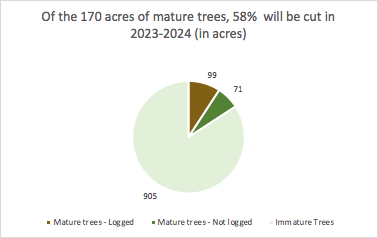
The remaining 905 acres of the forest (in light green in the above chart) have trees ranging between 8-45 years old, too young to cut). Even as the older trees in this area mature, it won’t be cost effective to log them until 2050. So until 2050, cutting these trees for revenue to pay operating costs will not be a viable option.
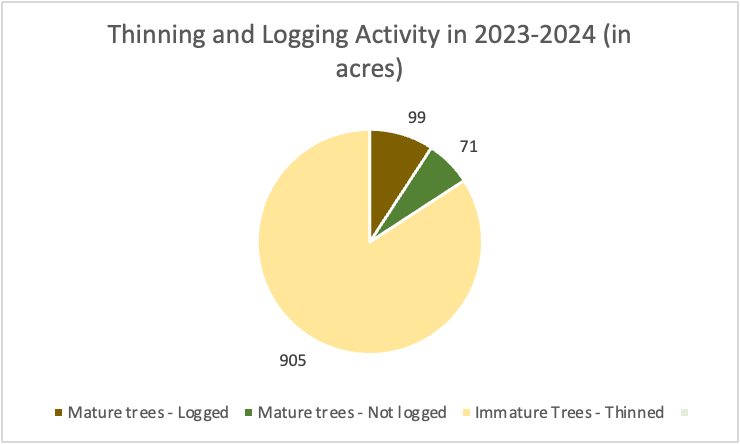
Also in 2023-2024, ALL of the 905 acres of immature trees (100%) will be thinned for the “health” of the forest (at a projected cost of $225,000 – click here and check out Timber Stand Improvement line item on page 4 of the financial plan).
STORY #2
Page 2 of the Q&A: “The cuts [for forest health] that have been proposed are smaller, less frequent cuts. The current harvests are intended to generate revenue and to improve forest health. Harvests solely intended for forest health would be smaller but would still occur “up front” to increase the financial feasibility and decrease the cost of treatment. It is difficult, if not impossible, to attract contractors if a treatment is too small.”
Note: These cuts for forest health are definitely not small (100% of the immature trees will be thinned which is 84% of the entire forest that can be logged.)
Page 3 of the Q&A: “Planned 2023 operations include selective logging, a combination of thinning, variable retention, and group selection (small patches) on less than 150 acres. Thinning of a 12- to 14-year- old replanted stand will also occur to improve forest health. The acreage includes all of the near-term logging proposed in the financial plan.”
Note: The total acreage of thinning work is 905 acres and not “less than 150 acres”.
THE QUESTION
Which story is correct? Or is it really something else?
Are 905 acres to be thinned (at $225,000) OR is less than 150 acres to be thinned (at less than $50,000)? Depending upon the story, there is a significant difference in cost and in the impact on the forest.
In the 2023-2065 version (click here for the full story), STORY #1 says that 61.5 % of the entire forest will be removed. STORY #2 says that “There is no plan to remove 62% of the forest“. How much will be removed? The revenue stream outlined in the operations financial plan is based on removing and selling 62%.
Both stories are from the Board and/or their Sustainable Northwest Consultant. It is understandable how the Board may not be aware of, or may not totally understand, the complexity of operations financial plan or what is being communicated in the Q&A. However, the Board is responsible for managing and overseeing consultants and staff. It is for reasons like this that having a volunteer, elected, part time Board to manage and oversee the forest is a financially risky proposition for the ratepayers who are owners of the forest.
 A.C. Water District Board (Go to Home Page)

2 responses to “#8 – Logging the Watershed: Which Story to Believe?”
could you tell me what the large red dot and the small green dots are on the map of the 2023-2024 map? it saddens me that they feel like logging is necessary. the discrepancies are troubling as well as the local coalition not being heard as an active participant. Do i have all this right? i’m a home owner, own the little 2 story next to Micah Cerelli. i don’t live in Oregon. i’m in Olympia. thanks cheryl waitkevich
>
LikeLike
Hi Cheryl. The red dots are access gates and the green dots are culverts. I agree with both of your concerns – the discrepancies and the lack of the Board’s involvement of ratepayers who are the owners of the forest which is in our backyard. Bill
LikeLike