With the adoption of the budgets and the contract approvals all but one piece of the jigsaw puzzle has come together for our next fiscal year – July 1, 2025 through June 30, 2026. Due to the election process for write-in candidates, there is still some uncertainty about the boards.
This communication covers work underway in the following areas:
- The Organization of the Districts as of July 1
- Key Projects for next fiscal year
- Budgets, Rates and Fees
- Progress on District Rejuvenation Projects
The Organization of the Districts as of July 1
A. The Board membership itself is still unclear and will remain so until at least the middle of June.
Water District Board:
- Position 1 – Tevis Dooley
- Position 2 – 9 write-in votes (could be for one or multiple “unknown” candidates)
- Position 3 – 33 write-in votes. Vegas odds are on Richard Petrich
- Position 4 – 8 write-in votes (could be for one or multiple “unknown” candidates)
- Position 5 – Sam Garrison
Sanitary District Board:
- Position 1 – Casey Short (re-elected)
- Position 2 – 28 write-in votes. Vegas odds are on Doug Caffall
- Position 3 – Mark Engberg (newly elected)
- Position 4 – Position recently resigned – but not on ballot
- Position 5 – Tom Mattia
From County elections:
We will not be able to have the names of the elected write-in positions until we certify the election. Certification will be completed by June 16th. At that time we will have the names of the winners or will know if there will be a recount.
We will then notify the winning candidates in writing by June 27th to see if they accept or decline the position. They are not officially elected until they return the write-in acceptance form, which is due from them by July 2.
B. The updated organization structure is:
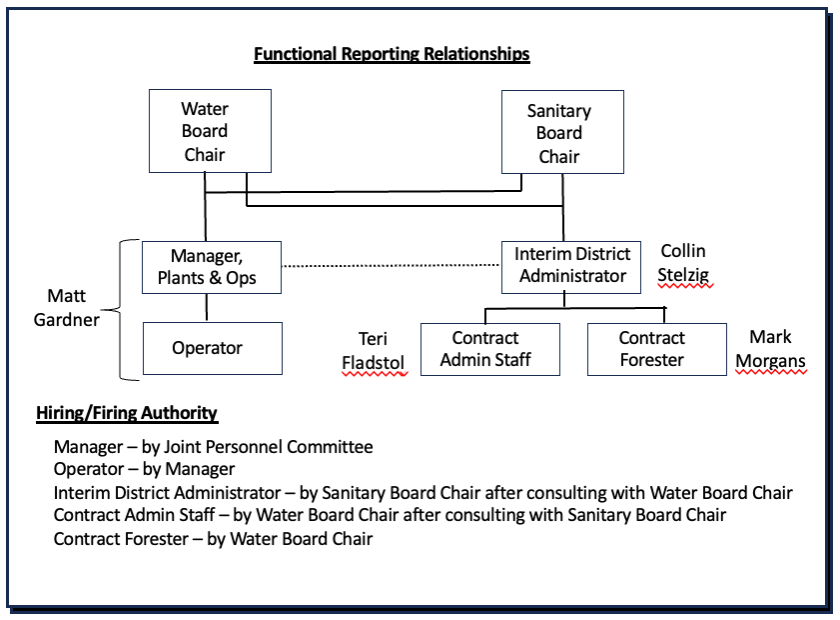
- Administration Responsibilities: A complete set of contracts is now in place with the Interim District Administrator, Admin Staff and Forester. Collin Stelzig will be taking on the Administrator duties previously done by Bill Campbell and Casey Short.
- Operations Responsibilities: Matt is still handling all operations duties by himself and using contractors as they can be found to fill in needs. Hopefully, a candidate(s) for one of the open positions will present themselves soon. Both positions are budgeted and unused salary and benefit dollars are being used to pay for the costs of temporary contract help.
Key Projects to be undertaken
In addition to keeping the business & operations ongoing and trying to catch up with the long deferred preventive maintenance (a daunting task), the following are the key projects that have been budgeted.
Water & Sanitary Districts
Geographic Information System: The Districts have funded the necessary resources so that all of the underground infrastructure – sewer & water lines, manholes, gates, valves blowoff, etc. can be electronically mapped into a Geographic Information System (GIS). This will replace 1970 vintage paper maps allowing staff to locate things more quickly and track history of work done/ needing to be done. Staff will now be using the GIS resources to physically go through the District to create the electronic map. (At the June 19th Board Meeting, Matt will be giving a briefing on this work.)
Water District
- Underground infrastructure: Identify the highest priority underground gates/ valves that need replacement or repair and address at least the most critical ones.
- Plant Instrumentation: Replace the failed ph sensors and turbidity meters in the water plant. These are instrumentations that are essential to monitor the functioning of the plant as it produces water.
- Plant redundancy: Replace/repair other critical equipment at the water plant to put back in place the redundancy as originally designed.
- Hydrant protection: Install bollards to protect fire hydrants in high traffic areas.
Sanitary District
- Underground sewer pipes: The absolute #1 priority is to identify, set priorities and replace/repair the 40+ year old sewer lines that have not been maintained over the past 8-10 years and have become cracked, damaged and leaking. This damage to the pipes allows volumes of rainwater and sediment material to find its way through the pump stations and into the sanitary plant. Processing this additional volume decreases the capacity of the treatment system. For every 30,000 to 40,000 gallons of water that are used by the community, more than 300,000 gallons are processed by the wastewater plant during heavy rainfall events.
- Wastewater Treatment Process: Clean the Anoxic Zone and repair valves and pumps. The Anoxic Zone is the part of the treatment process where raw sewage is mixed with micro-organisms to create an active treatment environment.
- Lab equipment: Replace and enhance lab equipment to meet increasingly demanding Department of Environmental Quality (DEQ) requirements and to reduce staff time spent in lab processes.
- Lift Stations: Begin the process of refurbishing the North End and Asbury creek lift stations, which will be a multi-year projects
- Transition to Starlink: Replace Spectrum internet services with Starlink to save $200+/month and to provide internet capability to the plant even when Pacific Power has an outage that brings down Spectrum. (Water Plant use of Spectrum is a successful case study.)
Budgets, Rates and Fees
The budgets have been adopted by the Boards and the Long Range Financial Plans (LRFP) have been accepted. Click here <Budgets & LRFP> and click on the “+” for water and sanitary.
The new quarterly rates, which include debt surcharges, for water usage up to 5,000 gallons/month are:
| District | ¾ inch | 1 inch |
| Water | $ 203 | $ 247 |
| Sanitary | $ 300 | $ 300 |
| TOTAL | $ 503 | $ 547 |
Excess Usage Charges
| Usage Amount per Month | Water | Sanitary |
| 5,001 – 8,000 gallons | $0.60 per 100 gallons | $0.26 per 100 gallons |
| 8,001 – 12,000 gallons | $1.79 per 100 gallons | $0.78 per 100 gallons |
| 12,001 – 16,000 gallons | $11.93 per 100 gallons | $10.40 per 100 gallons |
| 16,001 – 25,000 gallons | $21.53 per 100 gallons | $18.72 per 100 gallons |
| 25,001 and up | $35.88 per 100 gallons | $31.20 per 100 gallons |
Click here for a more detailed explanation of the excess use fees.
Progress on District Rejuvenation Projects
In addition to standard operations tasks and addressing unexpected challenges that present themselves, the following progress has been made this month on the FY2024-2025 budgeted rejuvenation projects listed below – with green indicating completed. (The complete set of projects with status can be found by clicking here.)
- Project 1 – Replace Operations Control Electronics for the Water Plant. JUST COMPLETED
The capability for broadcasting plant alarms to Staff members by text in addition to email has been fully implemented.
- Project 2 – Replace Webb Lift Station. COMPLETED
The lift station has been fully online and operational. Punch list items are being completed before final payment to the contractor is made.
We are working with OEM to see if we can find a way to get reimbursed for the final $150,000 of the FEMA grant that we were awarded.
- Project 3 – Upgrade & Bring Current the Business/ Admin Computer and Data System. COMPLETED
- Project 4 – Find, Compile, Electronically Store and Provide Access to Required Business Documents. AS TIME ALLOWS
- Project 5 – Implement an Asset Management System. COMPLETED
- Project 6 – Upgrade & Bring Current the Districts’ Web Site: COMPLETED
- Project 7 – Inspect Water Lines for Lead. COMPLETED
- Project 8 – Corrosion in Water Plant. COMPLETED
- Project 9 – Replace Operations Control Electronics for the Sanitary Plant. COMPLETED
- Project 10 – Move Asbury Creek Intake. IN PROGRESS
 A.C. Water District Board (Go to Home Page)