The Community’s Perspective on the National Park Services Recommended Policies and More
The Water District Board (Board) extends appreciation to everyone that completed a Public Access & Recreation Survey. Your feedback gives the Board a better understanding of the interests of the community regarding Public Access and Recreational Use of the Watershed. Below is the survey’s Methodology, Charted Results and Individual Commentary.
The Board will use this information to draft a Proposed Public Access and Recreation Policy for comment by Arch Cape rate payers and lot owners and then submit it to the Oregon Department of Forestry per our contractual requirement.
A. Methodology
The Public Access & Recreation Survey was built upon the work done by the Arch Cape Forest and Rainforest Reserve Public Access Team facilitated by the National Parks Service (NPS). That work included: a) a Public Access Management Plan, and b) the public comments on that Plan.
In reviewing the Public Access Management Plan (click to see the full plan) and the associated Public Comments (click to see the comments), the Board found that:
- The 75-page Management Plan along with its 71-page Appendix is extensive. Its information can be generally categorized as background-context information, planning process information, policy-related information.
- The sections of the Management Plan that are most relevant to a Watershed Public Access & Recreation Policy to replace the District’s current interim Policy can be found on pages 26-32, 57-58, 67. Page 67 is titled ‘Public Access and Recreation Policies’, (click to see the Proposed Policies on the NHS-facilitated committee).
- The Management Plan’s Policy Recommendations on page 67 do not specifically reflect the following topics that segments of the Community have raised in regards to Public Access & Recreation and would like the Board to address.
- Whether public access should be allowed across the Watershed or only outside of the Source Water Protection Area.
- Whether awareness of the Watershed should be promoted /publicized.
- Whether District resources (staff time and funding) should be used to manage vehicular site visits / tours into the Watershed.
- Public Comments about the Management Plan were submitted by 29 respondents. Since respondents were not asked to identify who they were or where their property was located, it is impossible to confirm whether these comments were submitted by rate payers and lot owners. 20 of the survey respondents did respond “yes” to the question about whether they are a rate payer.
- The Public Comments were general in nature and not specifically targeted at the Management Plan’s recommended ‘Public Access and Recreation Policies’ that are listed on page 67. Some of the respondents submitted comments about some of these policy recommendations, but those comments are not categorized in any organized or statistically significant way.
Before drafting a Proposed Policy for the Watershed, the Board wanted additional, more statistically representative feedback from Arch Cape Water District rate payers and lot owners about the Management Plan’s recommended ‘Public Access and Recreation Policies’. To do so, the Board developed and tested a 16 question Public Access & Recreation Survey. The survey focused primarily on the Policy recommendations contained on page 67 of the Management Plan and incorporated the pros and cons pertaining to each of those recommendations that were contained in the Management Plan. The survey also asked respondents to address the three additional issues identified above that have been surfaced by the Arch Cape community but were not addressed within the Management Plan’s specific Policy recommendations.
To ensure that Survey results would be specific to Arch Cape rate payers and lot owners, respondents were asked to identify their name and property location. Respondents were assured that this information would only be used to confirm eligibility and not for distribution.
The Public Access & Recreation Survey was posted on the District Board’s archcapeforestconversations.com web site. An invitation to participate in the Survey was sent to 416 email addresses that have been compiled over time to include, but may not be limited to, Arch Cape Community members (registered voters, rate payers and tax payers). The survey was open from July 20 to August 18. Over that time. 161 respondents identified their name and property location and completed the survey. Of that 146 met the survey eligibility requirements.
The results below reflect those responses of the 146 eligible respondents.
B. Next Steps (Tentative Dates)
The Public Access Management Plan and the associated Public Comments from the NPS facilitated workgroup along with the results of the Arch Cape Community Survey will inform the drafting of a Proposed Public Access & Recreation Policy for the Arch Cape Watershed.
1. The Board will consider / discuss this Proposed Draft Policy at the September Board Meeting, may make refinements and will post the Proposed Draft Policy.
2. The Arch Cape Community will be encouraged to send comments about the updated Proposed Draft Policy to the Board between the September and October Board Meetings.
3. At the October Meeting, the Board will consider all public comments and adopt a Draft Policy that will be submitted for approval to the Oregon Department of Forestry (ODF), per our contract requirements with the Forest Legacy Program.
4. Once the Policy is approved by ODF, the Forest Management Committee will consider and make recommendations to the Board about any enforcement issues.
5. The Public Access & Recreation Policy for the Arch Cape Watershed will be adopted by the Board.
C. Charted Results
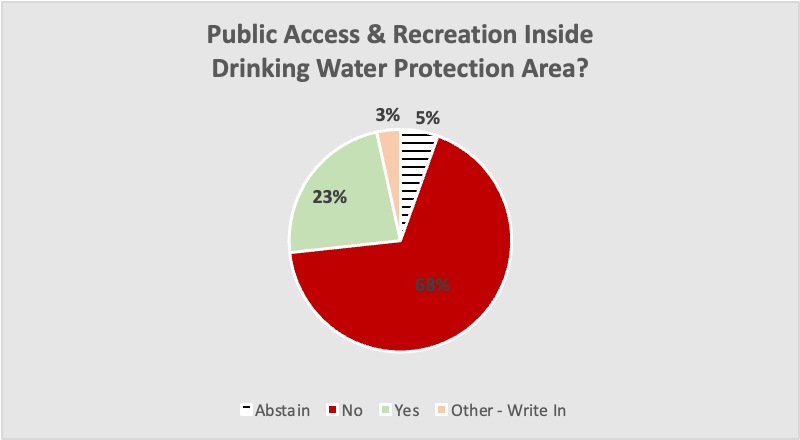
1. More than 2/3 of respondents DO NOT WANT public access and recreation inside the drinking water protection area.
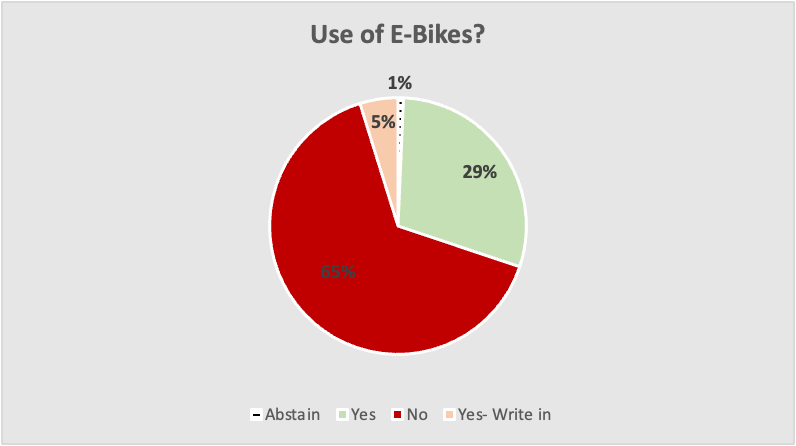
2. Almost 2/3 of respondents DO NOT WANT E-Bikes to be allowed, except for emergencies.
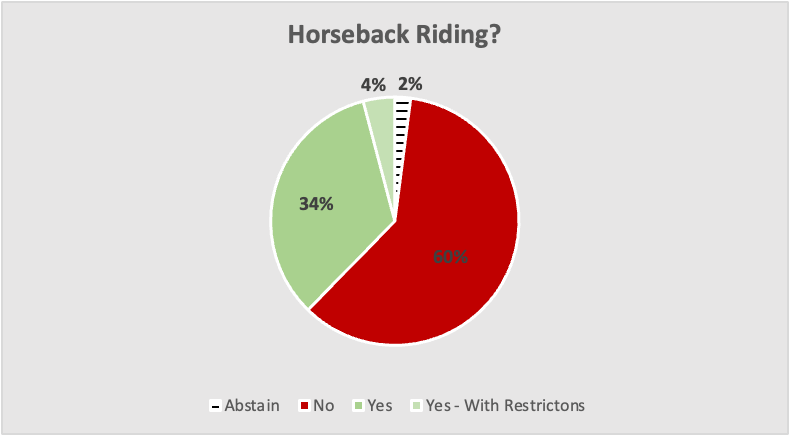
3. Almost 2/3 of respondents DO NOT WANT Horseback Riding to be allowed.
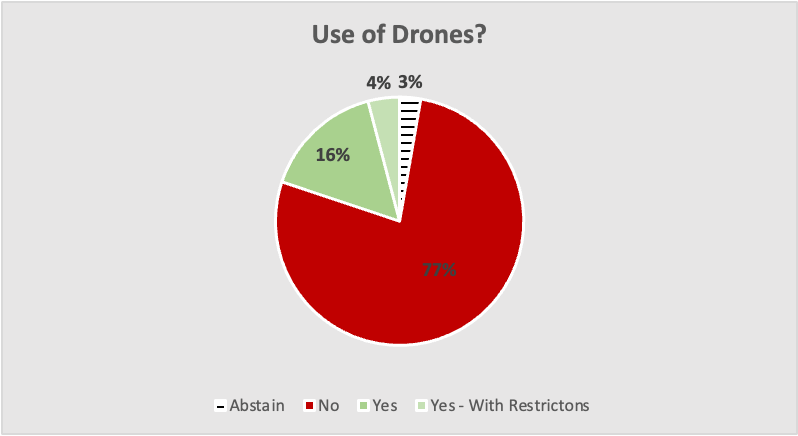
4. More than 3/4 of respondents DO NOT WANT Drones to be allowed, except for emergency and District use.
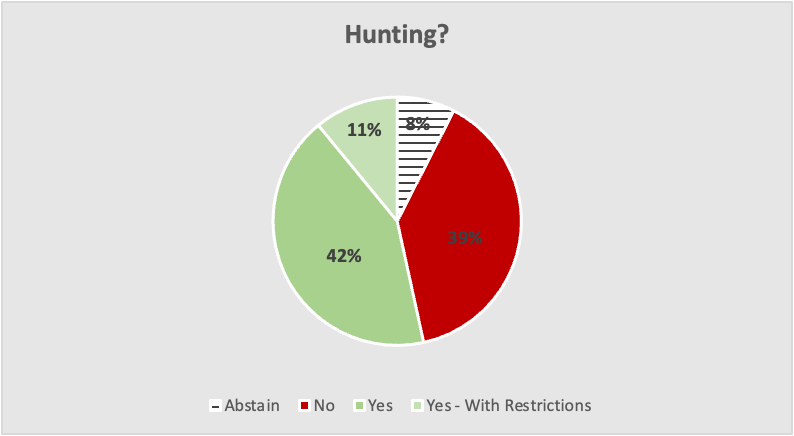
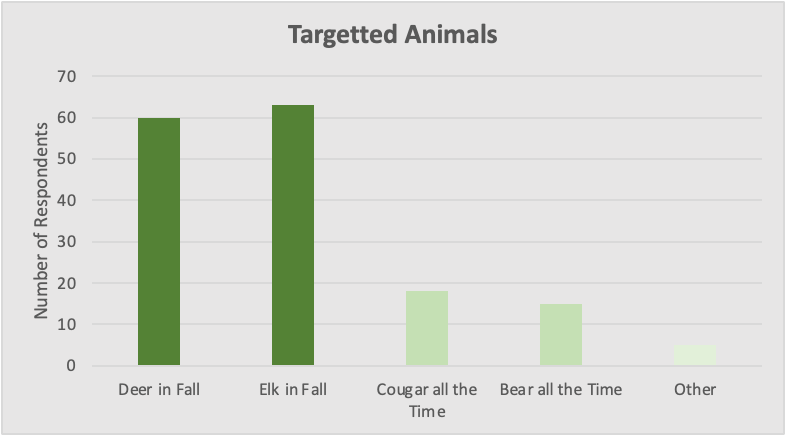
5. More than 1/2 of respondents WANT Hunting to be allowed, with some restrictions.
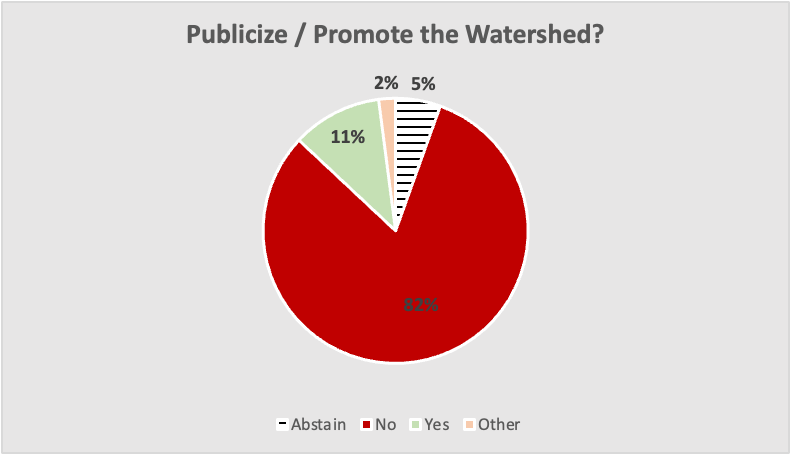
6. The vast majority of respondents DO NOT WANT Publicity / Promotion of the Watershed.
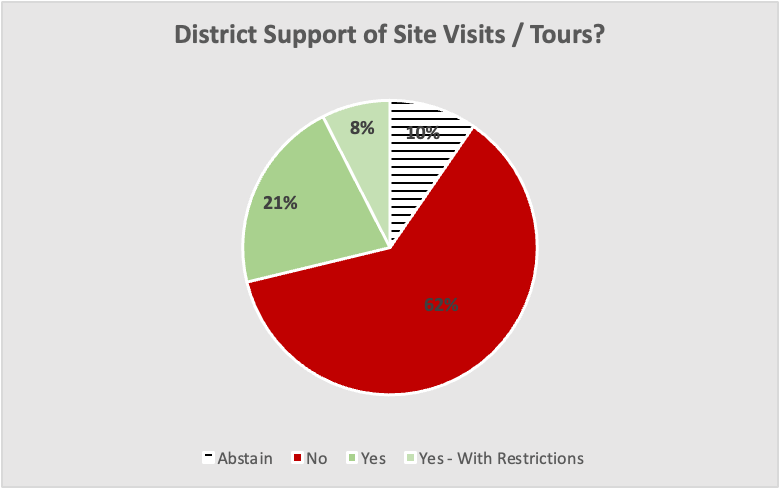
7. Almost 2/3 of respondents DO NOT WANT Site Visits / Tours in the Watershed.
D. Individual Commentary
1. About public access and recreation in the Source Water Protection Area.
| I believe most of Arch Cape is wanting limited access. Not publicizing access nor promoting it. |
| Keeping our watershed protected from any unnecessary intrusions/ public access is the overall goal. Outside of the drinking water source area should be lightly tread as well with local hiking, foraging, as it has been historically with no encouragement of general public recreation…. ITS A WATERSHED.. not a state park. |
| Just leave the road it’s fine |
| It seems excessive to prevent access to half of the land to protect drinking water. Is there a compromise that protects 30% to 35% of the drinking water aligned area, perhaps the area most sensitive to human presence or most important to the watershed? |
| Hiking outside inking Water Source Area only. |
| Priority is to protect the water source area |
| If public access becomes a problem just close it off to the public. Our drinking water is more important than public access. |
| If the project was truly about source water protection, than the only way to guard that to truth, is to shut down the source water protection area itself. This includes vehicular access for tours and the like. I would defer to Mr. Atwood in regards to allowing hunters inside the area for population control measures however, I would investigate that part closer as well and get his opinion. |
| If access is allowed inside and outside the watershed, dogs should only be allowed on leash. |
| We should be establishing a system of approved use that is supplemented by an openness to granting permits for particular uses that as named in the above survey. This will be an administrative responsibility of the district but it could be extremely useful. |
| A trail south of the green gate should be considered with a time period allowed for submission of routes. Safety and localized erosion concerns |
| I don’t feel like I know enough information about impacts to make an informed decision here. |
| This is a tough one for me to conclude a thought on. If recreation were to remain minimally impactful as it has been in the years leading up to now. Then I see no problem allowing access throughout. However if recreation becomes greatly increased or an issue then I see the importance of closing down access to the water source.. |
| Leave it alone-No |
| Limited public activity and only outside the physical drainage of the water supply |
| I could be wrong but I don’t see this area being bombarded with people. Again, revisit on an annual basis and modify the decision if need be. |
| Get rid of the old road |
| As it is today and has been for the 44 years I have lived in Arch Cape, there will be relatively little recreational use, and hopefully no one cooking meth. |
| Do not want ACWD residents to pay for improvements that only assist public access. |
| I like to know how this will be enforced, if so what is the cost involved ? |
| Only hiking on established roads to be permitted in the Source Area, which should be clearly marked with signs. |
| I’m confused why you couldn’t allow access and not be required to maintain a trail with a bridge. I vote for access without a trail and bridge. There are many places on the old logging roads where the road has been washed away and has not been maintained. |
| Same as previously. We need to maintain the integrity of the drinking water source area. This is a huge deal and needs to be maintained well. |
| Inside and outside public access restricted to residents and their guests, and for NCLC purposes. I consider scientific research backed by a land grant university should be allowed as an activity under public access and recreation. |
| Can you limit the public access to the watershed area? |
| Goal is to preserve and maintain clean water source. We are not buying for recreational or other uses. Risk for fire and contamination not worth it. |
| Public access without strict enforcement which there will be no enforcement. will lead to homeless camping , illegal fireworks, crime, litter, etc. and whatever those that are out of reach of the public and authority will do. and Fires which there are very limited ways to fight them on wooded hillsides. |
2. About Recreational Activities
| Pedestrian hiking by Arch Cape residents |
| referring to #6, the watershed is not in the business of providing a food source and the discrimination argument could be applied to any of the items listed above. Hunters are not being singled out nor discriminated against. It’s a safety issue. |
| I’m Opposed to fishing, as the creeks in our watershed are intended to be protected …left alone, which is basically a major aspect to ANY watershed. |
| Just don’t build a new parking lot or advertise it. There are enough people out here already and keeping it how it currently is but allowing e-bike for people with mobility issues is the way to go. You will for sure get homeless camps if you put a parking lot in. |
| Hunting in an area with people hiking makes no sense at all. Should we all wear orange vests while hiking? I would be open to hunting only if it is possible to create an easily observed area only for hunting that is far away from hikers (e.g. a stray bullet could not find its way to a hiker). I would also limit to deer hunting in this protected hunting only area. |
| Hiking only |
| Keep it as clean & simple as possible |
| Avoid disturbance of soils, invasive species and fire risk |
| Provide easy and safe access for day hikers. No overnight camping or stays. Manage any hunting or other activities that make it safe and enjoyable for hikers and visitors. |
| Allowing hunting in a watershed can have its share of cons and negative impacts. Some of the potential disadvantages: Threat to biodiversity: Uncontrolled hunting can lead to the depletion of certain animal species, particularly if targeted species are not managed sustainably. Overhunting can disrupt the natural balance within the ecosystem and may result in the decline or extinction of certain species, negatively affecting biodiversity. Disruption of food chains: Hunting can impact the dynamics of food chains within the ecosystem. Removing certain predator species through hunting can result in a population explosion of their prey, leading to imbalances and potential negative effects on other species within the food chain. Habitat disturbance: Hunting activities, such as creating trails, setting up blinds, or using vehicles, can lead to habitat disturbance and fragmentation. These activities can have adverse effects on the flora and fauna of the reserve, affecting nesting sites, breeding grounds, and disrupting the natural habitat of various species. Increased human-wildlife conflicts: Hunting may bring humans and wildlife into closer proximity, potentially leading to increased conflicts between the two. In some cases, wounded or aggressive animals can pose threats to hunters and local communities, leading to safety concerns. Poaching and illegal activities: Permitting hunting in a reserve can inadvertently provide cover for illegal poaching activities. It becomes difficult to distinguish between legal hunters and poachers, making it challenging for authorities to enforce hunting regulations effectively. Stress on sensitive species: Some animal species may be more sensitive to hunting pressure, especially those with slow reproductive rates or small populations. Allowing hunting in the reserve may put additional stress on these vulnerable species, exacerbating their decline. Disruption of ecosystem services: A healthy ecosystem provides valuable services to the surrounding areas, such as water purification, carbon sequestration, and flood control. Hunting can disrupt these services by altering the natural balance and function of the ecosystem. Ethical and moral concerns: Some people may object to hunting on ethical or moral grounds, believing that killing animals for recreational purposes or trophies is unjust and inhumane. Loss of genetic diversity: If hunting targets specific animal groups, such as large predators or prized species, it can lead to a reduction in genetic diversity within the population, which can have long-term consequences for the health and resilience of the species. |
| We don’t want the area overrun with recreational activities. By requiring permitted use, we can deliver guidelines, collect a small nominal use fee, and better educate those that use the area. |
| Nothing about trails. Is hiking only on roads? Are there or will there be any trails (e.g. to AC creek falls), or will hiking be cross country? |
| Hunting. Allow it. Defer to Mr. Atwood and ask that he and his team craft and hunting plan that allows for safe and necessary hunting activities as his team of educated staff see necessary to best serve the property and the populations. We are not experts in this and should defer to him for advice. |
| Dogs should be on leash only. Too many locals think everyone should meet and greet their wet, smelly off leash dogs. There’s already so much dog poop along the trail past the sewage facility that people can’t walk in the grass. Locals need to get over themselves and their free range dogs and start taking responsibility for their waste and stop planning to ignore when Fido squats down for relief. It’s laughable the way local dog owners act oblivious to their squatting dogs. |
| I am of the opinion that the community should allow certain activities but only under a clear permit requirement, |
| walking, running, and manual cycling in groups under 6, m/l more than that would need to apply for permit by email with activity description Large groups can cause substantial degradation of the experience of others |
| Generally I believe the watershed should allow without promotion. Hiking & pedal biking. It is a protected pure space for the arch cape water supply. And should therefor be experienced in the most pure forms. |
| Plan to place good signage throughout the RF Reserve, roadhead at Hug Point, at the boundaries of the Watershed. |
| Leave it to hiking only! |
| Regardless of the permitted activities decided on, I am opposed to promotion of the area for outdoor activities. |
| We will have to figure out access issues through Butch’s property and how to keep vehicles from parking on Shingle Mill or any dead end connecting roads. No publicity for the entire property saying it’s open to the public. No public access in watershed. |
| It’s a beautiful area, let others enjoy it. If the forest/wildlife/resources are being negatively impacted, then access can be modified We have grandkids that play in the woods behind our house, which is next to the forest, I would be livid if someone was shot from a hunter or if they saw an animal get shot! |
| In general would agree to “leave in nature” the entire watershed. Hiking is OK and I could be convinced that managed hunting, with posted areas around housing areas, might be acceptable. |
| Hiking and access to views |
| Walkers and runners. |
| Limited day use for hiking and foraging is fine. Activities that might be detrimental or dangerous to these activities should not be permitted. |
| Keep it open! |
| Hiking, no hunting or fishing, no motor driven vehicles, no horses. |
| I’m wondering if there is a limit to how many hunting permits are given out each season for this area? Not a fan of hunting, however in consideration of the people who responsibly hunt, I’m willing to compromise. When it comes to controlling the deer and elk populations it is important to leave the cougars alone. Bear population here is not an issue, so leave them alone also. |
| We should have an area (probably north) outside of the Source Watershed suitable for enhanced access such as disabled, wheelchairs and maybe e-bikes. |
| Allowing me and my dog the ability to hike in the watershed is my top priority. |
| I appreciate maintaining many of the traditions and access that is currently provided. However, I feel like we have a unique gem in this space, and we have a responsibility to maintain it to a high level for us and generations to come. So while my answers fit this state of mind, I would err on the side of caution and limit recreational activities. |
| foot traffic only to provide a natural experience |
| No hunting of any kind. The concern is safety, accidental shooting and is a fire risk. Hunting also promotes many cars and trucks parked on the roads. No foraging except for berries for personal use. Foraging for mushrooms, plants, leaves, flowers is too disruptive. I have seen the result of foraging activities from active groups and their “for personal use” can be hundreds of pounds! Ads targeted to Portland community for foraging classes occur multiple times during summer with large groups already. National Park public access is too liberal. Unlimited public access should be limited to residents and their guests only. |
| Keep it for hiking only, as natural as possible |
| Recreational day hiking trails should be present and available away from water source to protect our waterways. |
| Drones should be allowed for emergency purposes not recreational. |
| Just hiking and biking |
| Keep the watershed open for hikers. |
| No promotion at all |
| I believe access should be very limited as this is our drinking water. I am concerned as I often see the waste people leave behind at the beach. |
| Access should be limited and regulated based on the close proximity to our drinking water. I notice the waste that is left on the beach. |
| its a water shed and any contaminants will affect all of our water negatively.. and we are paying and maintaining it not for others to abuse our life resource. which will eventually happen. |
3. About Promoting / Publicizing the Watershed
| It feels contradictory to promote a watershed. |
| For the love of god don’t do it…. Have you seen Oswald West, Hug Point etc…. You want that in our back yard? |
| Need to find the balance between allowing for public knowledge and creating an Oswald mess of traffic and people during the summer months. |
| Would bring in too many people |
| Promotion may lead to use of watershed by those not familiar with rules/regulations or watershed objectives and would increase maintenance costs |
| More people more problems. This is a local piece of property that the community pulled together to make available for additional use. |
| By having a permit process, a nominal fee, and guidelines for use, this would make the access reasonable and safe for all. |
| Hunters have hiked throughout the hills in and around the AC Forest. Some publicizing of expectations/restrictions of access to the forest and watershed will be necessary (perhaps at access points). |
| All media, should be removed immediately. This is our drinking water source protection area, not a political tool for organizations to use for there own gains to acquire more properties. Arch Cape ratepayers deserve the protections of the source water. |
| No need for direct promotion/publicizing |
| Publicize via website but no outreach promotions |
| Hikers and users will find the required information if it’s on a single site. Prefer no promotion of the resource. |
| Absolutely Not!!! |
| It’s not unreasonable to assume that agencies and partners who collaborated to help purchase the watershed might reference the successful cooperation. That is not the same as encouraging folks to visit. |
| I think informational signage referring to the importance of the watershed / drinking source, and info about allowed use, located on gates within the watershed would be helpful. All other signs or promotion would negatively impact the watershed. |
| Why? This is our watershed keep it just the way it is! |
| OK to advise the public that the land is owned by the WD for the purpose of protecting the drinking water supply. Do not advertise any availability for hiking, biking, hunting . . . |
| Let people come if they want, but to advertise means money will be needed to fix roads/trails, have sufficient parking and provide bathrooms. Where does that come from? |
| This land was purchased with funds taken from rate payers. It should therefore fall to rate payer use first. Publicizing it will only increase the cost to upkeep and maintain the land, resulting in a higher financial burden on rate payers. |
| Less general marketing and more true local and land loving users |
| This right here, is a very very stupid idea…. |
| Signage, maybe, on site, just as there are signs at the head of beach access. I resent people who want their immediate surroundings kept private without consideration of the rest of us. |
| The last thing Arch Cape needs is an influx of Portland day trippers and the melange of miscreants to burden Cannon Beach with their trash, noise and dune defecation etc |
| Not a good Idea ! |
| We need to give the land and the watershed several decades to recover from human use. Intelligent management, favoring nature over exploitation. |
| Unsure why we would want to publicize it. There is nothing to be gained by having more people in the space. It risks trespassing into the drinking water area and damage to our water. |
| No promotions and no signs. Exceptions: to allow NCLC activities by invitation only, allow NCLC to continue their unique publications that increases the awareness of biodiversity and protection of the area, and for scientific research purposes, backed by land grant universities and governmental agencies. |
| Signage on gates, not signage on Highway 101 |
| I think signage of allowed uses should be clear at any entry gate. And there should be information on the Arch Cape Forest And/or Water District website. |
| If it has public access, are we required to provide parking and restrooms? |
| Leave it alone no promotions at all |
| No promotion or publications Take a look around us |
| Don’t |
| Advertise and it will get overrun with those not wanted. |
4. About Site Visits / Tours in the Watershed
| I do not think that Arch Cape water district staff members should spend time coordinating vehicular visits and tours. |
| Could the Watershed charge a fee for site visits/tours to cover costs incurred? |
| Educational reasons seem reasonable but not to publicize watershed. keep the budget for this on a realistic level. |
| no vehicles except for work and emergences |
| If you can do it for free that’s great. I don’t want to pay money for it I pay enough already. |
| This level of traffic would not be good and would lead to more erosion and risk to the watershed from trash, etc. Overcrowding would also be a risk that should be avoided. |
| Vehicular tours should be self supporting and limited |
| Tours provide education which is important to long term generational awareness of the watershed. Costs can be minimized by limiting the number of tours and/or extent |
| Arch Cape water district staff members should not spend time coordinating vehicular visits and tours. |
| It’s okay to say “No”. We don’t need to offer tours or visits. |
| It’s hard for me to answer this question without having more information (e.g. number of anticipated tours/year and their estimated costs). |
| No vehicles period! Walking, hiking running, horseback riding only. |
| No, costs to support vehicular site visits / tours into the Watershed should not be included in the long range financial – operations plan because there should not be vehicle site visits tours. |
| I think a twice a year planned tour would be educational and helpful for promoting the value of this resource. |
| Recommend volunteer AC Forest docents lead tours for reasons 2&3. |
| So…..Rate payers should pick up the costs for neighboring land owners to move there agendas forward and put at risk our source water….no. This is not a “show and tell”. This was done for source water protection and was fear mongered against the public as such. |
| The two employees of the district couldn’t maintain the multimillion dollar sewage facility when the forest acquisition took priority, so now that they have a less experienced staff how would they coordinate tours and the like without taking time away from the years of maintenance that went undone under Phil Chick? Come on |
| I feel that there is no no need for tours publicizing the watershed. But YES, to educational research and advocacy. I feel that raising the issue of administrative costs for site visits in this survey item is misleading in that it overemphasizes the number of site visit requests. Clearly these are issues that can be determined as they arise. |
| These visits should be very infrequent, perhaps one or two per month, with an application / approval process in place |
| The visitors and users should fund any staff needed to organize and coordinate. |
| No Tourism visits Special case consideration for scientific or other watershed groups OK |
| No tourism visits. Scientific or other watershed groups on request |
| It seems most important to [specifically] focus on funding of the preservation and protection of the watershed in order to protect water abundance and quality (i.e. the reason we acquired the land). Tours and any funding should be considered further down the road. |
| Would need to cover all the districts cost. Along with making money for maintenance and salaries for the district |
 A.C. Water District Board (Go to Home Page)
One response to “Public Access & Recreation Survey Results”
Good survey results in my view; this area is prestige and should remain that way
Vicki Lord.
Address 111 Pacific Avenue, Arch Cape. Pete Szambelan’s home
LikeLike